Port Dickson is the second smallest district in Negeri Sembilan. It is geographically located on the west coast of Negeri Sembilan. It borders Seremban and Rembau on the east while Sungai Sepang and Sungai Linggi divide it from Selangor & Melaka respectively.
Formerly known as "Tanjung" to the Malays and "Alang" to the Chinese, Port Dickson derived its name from Sir John Frederick Dickson, the British resident responsible in developing the area into a significant trading port in the 18th century.
Now Port Dickson or more popularly known as PD has long been a weekend retreat for many inland dwellers, especially those from the city seeking to temporarily escape the hustle and bustle of a hectic life.
Friday, August 28, 2009


Thursday, August 27, 2009
perhentian island
Tourism
Perhentian Kecil seen from Perhentian Besar
Sheer beauty of Pulau Perhentian makes it the destination of tourists. Both the islands have palm-fringed white sandy beaches and turquoise blue sea. One can have a number of activities on its beaches and forests. Swimming and snorkeling are the most popular tourist activities here. On most beaches, the water is shallow with lots of rays, cuttlefish and parrotfish. For diving you could go to northwest Perhentian Kecil where you would find a group of small rocky islets. This is the best place to dive in Perhentian. Apart from these, you could also enjoy activities like camping, canoeing, fishing, jungle trekking, and banana boat riding. As for accommodation, most of it can be found on Perhentian Besar, the larger island. Hotels are usually aimed at budget travelers.
Tourism is the base of economic activity in Perhentian. However, owing to the Islands' protected status, the main tourist activities are minimal in environmental impact: sunbathing, snorkeling, scuba diving, turtle and shark-watching.
Tourist sunbathing at Perhentian
Summer 2007, 2 wind turbines have been installed, still not connected to the network in October 2008, Thus the island's electrical power is still provided by diesel generators. A third turbine is being built. Electricity is 24-hour during high season. Fresh water is provided by springs. In this respect, the Perhentian Islands are prized by tourists as an 'escape' from the modern world.
As the state of Terengganu follows Islamic customs, the consumption of alcohol and wearing of immodest clothing are discouraged. In order not to offend local inhabitants, tourists are advised to consume alcohol discreetly and to wear one-piece bathing costumes. No penalties are imposed on tourists for 'breaches' of the local customs, however.
Perhentian Besar beach
The only access to the Islands is by boat from the fishing villages of Kuala Besut and Tok Bali. Local tourist operators run fishing boats and speed boats several times a day.
[edit] Turtle Conservation
Boats at Perhentian Kecil jetty
The Perhentian Islands are home to a significant turtle nesting population. The island was once home to hundreds of nesting Green and Hawksbill turtles but now the islands only receive 300 nests per year. The Department of Fisheries http://www.dof.gov.my, are running a turtle hatchery on the islands to help readdress the declining turtle populations. The Great Marine Project http://www.greatmarineproject.com are complimenting the work done by the Department of Fisheries by protecting one beach on Perhentian Besar and educating visiting tourists. The Great Marine Project run an after-school marine club educating the local school children about marine conservation.
Perhentian Kecil seen from Perhentian Besar
Sheer beauty of Pulau Perhentian makes it the destination of tourists. Both the islands have palm-fringed white sandy beaches and turquoise blue sea. One can have a number of activities on its beaches and forests. Swimming and snorkeling are the most popular tourist activities here. On most beaches, the water is shallow with lots of rays, cuttlefish and parrotfish. For diving you could go to northwest Perhentian Kecil where you would find a group of small rocky islets. This is the best place to dive in Perhentian. Apart from these, you could also enjoy activities like camping, canoeing, fishing, jungle trekking, and banana boat riding. As for accommodation, most of it can be found on Perhentian Besar, the larger island. Hotels are usually aimed at budget travelers.
Tourism is the base of economic activity in Perhentian. However, owing to the Islands' protected status, the main tourist activities are minimal in environmental impact: sunbathing, snorkeling, scuba diving, turtle and shark-watching.
Tourist sunbathing at Perhentian
Summer 2007, 2 wind turbines have been installed, still not connected to the network in October 2008, Thus the island's electrical power is still provided by diesel generators. A third turbine is being built. Electricity is 24-hour during high season. Fresh water is provided by springs. In this respect, the Perhentian Islands are prized by tourists as an 'escape' from the modern world.
As the state of Terengganu follows Islamic customs, the consumption of alcohol and wearing of immodest clothing are discouraged. In order not to offend local inhabitants, tourists are advised to consume alcohol discreetly and to wear one-piece bathing costumes. No penalties are imposed on tourists for 'breaches' of the local customs, however.
Perhentian Besar beach
The only access to the Islands is by boat from the fishing villages of Kuala Besut and Tok Bali. Local tourist operators run fishing boats and speed boats several times a day.
[edit] Turtle Conservation
Boats at Perhentian Kecil jetty
The Perhentian Islands are home to a significant turtle nesting population. The island was once home to hundreds of nesting Green and Hawksbill turtles but now the islands only receive 300 nests per year. The Department of Fisheries http://www.dof.gov.my, are running a turtle hatchery on the islands to help readdress the declining turtle populations. The Great Marine Project http://www.greatmarineproject.com are complimenting the work done by the Department of Fisheries by protecting one beach on Perhentian Besar and educating visiting tourists. The Great Marine Project run an after-school marine club educating the local school children about marine conservation.
Wednesday, August 26, 2009
Pulau Ketam Tour

Pulau Ketam, or ‘Crab Island’ as it is called, is a unique island that is completely made of mangrove swamps with a village built on stilts nestled inside it. The island was named after the thousands of tiny crabs that appear on the shores during the low tide. What makes Pulau Ketam fascinating is that a visit here is like a journey back in time, where Chinese traditions, wooden homes and fishing are very much a part of life.
Far away from the modernity of the cities, Pulau Ketam allows visitors a fascinating glimpse of the rustic Chinese village that depend on the sea for fishing and farming. Things here are very much the same as it was century ago, when the first fishermen from China arrived at the shores of Pulau Ketam to begin a new life. Today, the village retains much of its ancient traditions, shown in the clan houses, ornate temples and peaceful personalities of the people.
During this tour, expect to visit a mangrove swamp and observe the amazing wildlife that occur here, from mudskippers and monitor lizards to majestic raptor birds and colourful crabs. After the mangrove swamp, it’s a detour to a fish farm where you get to see how Garoupa, Snapper and Barramundi fish are raised in nets for the aquaculture industry,
Break for lunch in one of the island’s most popular seafood restaurants and enjoy the freshest fish, prawns and crab you’ll ever taste before proceeding for a walkabout around the island. During this walkabout, which will either be on foot or bicycle, you’ll get to see aspects of life around this village, from one of the last traditional boat-builders on the island to an elaborate temple dedicated to seafood and fishermen hard at work drying their catch to a ‘Kongsi’ or Clan House, which was used by the first people on Pulau Ketam’s shores as a home.
Tuesday, August 25, 2009
redang
Redang Island
White sandy beaches, crystal clear blue sea, brilliant underwater world... Redang archipelago comprises 9 islands (Lima Island, Paku Besar Island, Paku Kecil Island, Kerengga Besar Island, Kerengga Kecil Island, Ekor Tebu Island, Ling Island, Pinang Island and the main Redang Island) that abound with marvelous marine fishes, turtles and coral reefs that ensure great snorkelling and scuba-diving. Ping Anchorage package tours from camping to luxury beach resort, the choice - is always yours !
White sandy beaches, crystal clear blue sea, brilliant underwater world... Redang archipelago comprises 9 islands (Lima Island, Paku Besar Island, Paku Kecil Island, Kerengga Besar Island, Kerengga Kecil Island, Ekor Tebu Island, Ling Island, Pinang Island and the main Redang Island) that abound with marvelous marine fishes, turtles and coral reefs that ensure great snorkelling and scuba-diving. Ping Anchorage package tours from camping to luxury beach resort, the choice - is always yours !
Monday, August 24, 2009
Like a giant sleeping dragon, the dark green ridges of Tioman Island rise up above the waters of the South China Sea. On closer inspection, it becomes clear that the dragon’s dark green scales are in fact giant trees and impenetrable jungle; that the grey claws are giant granite boulders and that the dragon’s horns are twin peaks with smooth, straight cliffs, surrounded with swirls of mist.
The dragon-like appearance of Tioman Island is at the root of a legend surrounding its origin: A dragon princess from China was flying to her prince in Singapore and stopped to rest in these calm, warm waters. Enamoured by the beauty of the area, and the waves lapping at her sides, she discontinued her journey and took the form of an island.
The natural beauty of the island is its biggest attraction. Lush tropical jungle covers about 12,000 hectares of the island and countless mountain streams and waterfalls sustain the many protected species of mammals and birds. The waters around the island are filled with corals of all shapes and colours and home to a vast diversity of sea creatures, including two species of marine turtle. There are a few excellent beaches on Tioman, and these curves of golden sand are usually tucked away at the edges of villages or fronting one of the many resorts.
Tioman has options for every kind of holiday-maker: families with small children, honeymooners, scuba divers, backpackers, adventurers and even those looking for a slice of exclusivity and luxury. Most places to stay are clustered around the villages that are dotted along Tioman’s coastline while there are a few small resorts that are built around private beach coves.
Tioman is the largest in a volcanic group of islands off the east coast of peninsular Malaysia. Getting there is simple as there is both a ferry service from Mersing on the mainland and an airport on the island itself.
Tioman is a beautiful, popular and affordable holiday destination so book ahead!
The dragon-like appearance of Tioman Island is at the root of a legend surrounding its origin: A dragon princess from China was flying to her prince in Singapore and stopped to rest in these calm, warm waters. Enamoured by the beauty of the area, and the waves lapping at her sides, she discontinued her journey and took the form of an island.
The natural beauty of the island is its biggest attraction. Lush tropical jungle covers about 12,000 hectares of the island and countless mountain streams and waterfalls sustain the many protected species of mammals and birds. The waters around the island are filled with corals of all shapes and colours and home to a vast diversity of sea creatures, including two species of marine turtle. There are a few excellent beaches on Tioman, and these curves of golden sand are usually tucked away at the edges of villages or fronting one of the many resorts.
Tioman has options for every kind of holiday-maker: families with small children, honeymooners, scuba divers, backpackers, adventurers and even those looking for a slice of exclusivity and luxury. Most places to stay are clustered around the villages that are dotted along Tioman’s coastline while there are a few small resorts that are built around private beach coves.
Tioman is the largest in a volcanic group of islands off the east coast of peninsular Malaysia. Getting there is simple as there is both a ferry service from Mersing on the mainland and an airport on the island itself.
Tioman is a beautiful, popular and affordable holiday destination so book ahead!
Friday, August 21, 2009
Batu Manikar Beach

Glorious sunsets. That is the one thing a visitor would not fail to notice about Labuan. You can view it all along Jalan Batu Manikar right up to where University Malaysia Sabah (UMS) is located.
When the skies are clear (as it mostly is in sunny Labuan), the magnificent sun behaves as it had for centuries past. Its brilliant disappearing act into the horizon performance will begin just after 6pm.
The famous Batu Manikar Beach-Layang Layangan is a great place to view such a sunset. It is a fabulously long stretch of beach fringed with casuarinas and coconut trees. A footpath circles most parts of the beach for the convenience of joggers and casual walkers, shaded naturally by the many trees. It’s a definite incentive for health buffs to exercise out there with the fresh air, breeze and fantastic view.
Batu Manikar Beach – Layang Layangan won the COBSEA Clean Beach Award 2008. The prestigious award is well-deserved as every morning municipal council workers can be seen hard at work cleaning the beach from any rubbish and debris.
Thursday, August 20, 2009
Redang Island

Redang Island, locally known as Pulau Redang or just "Redang" is one of the largest islands off the east coast of Malaysia. It is a popular holiday island for Malaysians, most of whom come on package deals to one of the resorts. Redang is one of nine islands, which form a marine park, and which offer snorkeling and diving opportunities. Access is from Merang or Kuala Terengganu on boats operated by the resorts; there is also a small airport with services operated by Berjaya Air from Singapore (Seletar Airport) and Kuala Lumpur (Sultan Abdul Aziz Shah Airport).
The island is also an important conservation site for sea turtles. Previously, the indiscriminate economic exploitation of turtle eggs had caused fewer turtles returning to nest on the island. This has led the Terengganu state government to set up the Koperasi Setiajaya Pulau Redang in 1989, a cooperative aiming to develop and manage socio-economic programmes that could improve the livelihood of Pulau Redang locals without endangering its natural resources.[citation needed]
The waters around Pulau Redang also contain two historic shipwrecks: HMS Prince of Wales and HMS Repulse. The ships were sunk here at the start of World War II, setting the stage for the Japanese occupation of Malaya.
The Pulau Redang archipelago comprises Pulau Redang, Pulau Lima, Pulau Paku Besar, Pulau Paku Kecil, Pulau Kerengga Kecil, Pulau Kerengga Besar, Pulau Ekor Tebu, Pulau Ling and Pulau Pinang. Pulau Redang is the biggest of all the islands in the Marine Park, measuring about 7 km long and 6 km wide. Its highest peak is Bukit Besar at 359 metres above sea level. The boundary of the Pulau Redang Marine Park is established by a line linking all points 2 nautical miles (3.7 km) from the shores of Pulau Redang, Pulau Lima, Pulau Ekor Tebu and Pulau Pinang. The other nearby islands of Pulau Perhentian Besar, Pulau Perhentian Kecil, Pulau Lang Tengah, Pulau Kapas and Pulau Susu Dara are also gazetted and protected as Marine Parks. Today, only the bigger islands like Redang, Lang Tengah, Perhentian and Kapas have resort facilities for visitors. The management of Marine Parks primarily involves protection of the sensitive marine and terrestrial ecosystems by controlling the impact from human activities. These include waste & pollution management and conservation of coral reefs and terrestrial habitats.
Wednesday, August 19, 2009
The Pulai Desaru Beach
The Pulai Desaru Beach lies in the heart of Desaru, Johor, one of the most beautiful unspoiled beaches in the east coast of Peninsular Malaysia. With a 22km stretch of uninterrupted beach, Desaru combines the captivating panoramic views of the South China Sea with the lush tropical rainforests, where visitors can have their choice of fun and adventure or simple rest and relaxation.
The Pulai Desaru Beach is owned and operated by the Pulai Springs Berhad Group, which has established its  reputation with its flagship development, Pulai Springs Resort in Johor Bahru. Pulai Springs Resort has won several awards and accolades including the 2000 World FIABCI Prix d’Excellence Award for the World's Best Resort Development, acknowledged by the Wall Street Journal to be “the most prestigious real estate award in the world”.
Tuesday, August 18, 2009
simpadan
Sipadan
From Wikipedia, the free encyclopedia
Sipadan is the only oceanic island in Malaysia, rising 600 metres (2,000 ft) from the seabed. It is located in the Celebes Sea east of the major town of Tawau and off the coast of East Malaysia on the Island of Borneo. It was formed by living corals growing on top of an extinct volcanic cone that took thousands of years to develop. Sipadan is located at the heart of the Indo-Pacific basin, the centre of one of the richest marine habitats in the world. More than 3,000 species of fish and hundreds of coral species have been classified in this ecosystem.
Normally rare diving scenes are frequently seen in the waters around Sipadan: schools of green and hawksbill turtles nesting and mating, schools of barracuda and big-eye trevally in tornado-like formations, pelagic species such as manta rays, eagle rays, scalloped hammerhead sharks and whale sharks.
A mysterious turtle tomb lies underneath the column of the island, formed by an underwater limestone cave with a labyrinth of tunnels and chambers that contain many skeletal remains of turtles that have become lost and drown before finding the surface. [1]
Contents[hide] |
[edit] History
In the past, the island was at the centre of a territorial dispute between Malaysia and Indonesia. The matter was brought for adjudication before the International Court of Justice and, at the end of 2002, the Court awarded the island along with the island of Ligitan to Malaysia, on the basis of the "effective occupation" displayed by the latter's predecessor (Malaysia's former colonial power, the United Kingdom) and the absence of any other superior title. The Philippines had applied to intervene in the proceedings on the basis of its claim to Northern Borneo, but its request was turned down by the Court early in 2001.

On April 23, 2000, 21 people were kidnapped by the Filipino terrorist group Abu Sayyaf. The armed terrorists arrived by boat and forced 10 tourists and 11 resort workers at gun point to board the vessels and brought the victims to Mindanao. All victims were eventually released.
[edit] Diving at Sipadan
In year 2004, the Government of Malaysia ordered all on-site dive and resort operators of Sipadan to move their structures out of the island by 31 December 2004. This move is mainly to conserve a balanced ecosystem for Sipadan and its surrounding.[citation needed].
Diving will continue to be allowed in Sipadan for divers who are ferried in and out by dive and resort operators from the mainland and surrounding islands. However, tourists and keen divers should be warned that the number of permits available for Sipadan each day is limited to 120 spread between 12 resorts. A visit to Sipadan is not only not guaranteed for guests at the resort, regardless of the length of stay, but it is highly unlikely for those who stay less than a week or who want to snorkel rather than dive. Please keep this in mind to avoid disappointment.
If you are lucky enough to get to dive at Sipadan, you'll experience world class diving, and maybe the most known diving spot is the Barracuda Point, where during the morning dive you'll often encounter a very large school of Barracuda or Big Eye Trevallies. This is only one of many rare experiences you'll have diving the reef off Sipadan island. There will be a lot of Green Turtle, Hawkbill Turtle and Whitetip reef shark and even the rare encounter of Hammerhead sharks.
Monday, August 17, 2009
Tanjung Rhu Beach

An archipelago of 99 islands in the Andaman Sea, Langkawi is a tropical paradise of lush foliage and dramatic cliffs. Set on Tanjung Rhu, one of the islands best beaches, Four Seasons Resort Langkawi combines indigenous architecture with gracious service in a resort experience unmatched in Malaysia. All 91 guest pavilions and villas offer the soothing sounds of the Andaman Sea and sensational views of sunsets beyond the beach. The generously sized guest accommodations are a fusion of traditional Malaysian design elements and contemporary resort features, with timber floors, soaring ceilings and large open verandas. Inspired by the traditions of indigenous artisans. Some villas and all lower-level pavilions include secluded outdoor bathing and showers that evoke the feeling of a gentle tropical rainfall.
| | |
|

Saturday, August 15, 2009
Negeri Sembilan in Malaysia

The state of Kelantan is known as the ‘cradle of Malay culture’ for having an overwhelming population of Malays (93 percent) and the rest made up of Chinese, Indians and Thai. The Kelantanese have preserved their customs, traditions and cultures well over the years. Some of their most memorable activities are flying giant ‘Wau’ kites and playing ‘Gasing’, a game of spinning tops.
History dates the origin of Kelantan from the ascension of a Thai prince Long Yunus to the throne. The state then went through Thai and British influences before becoming part of Malaysia in 1957. The name ‘Kelantan’ means ‘Land of Lightning’ evident by the many thunderstorms that rock the state each year.
While the economy of Kelantan is based on agriculture such as rice, rubber and tobacco, the state is much more famous for their Malay handicrafts which include ‘Batik’, a silky garment woven with intricate patterns, ‘kain songket’, a cloth made from gold and silver thread, mats, silverware, paintings and wood carvings.
Tourism is a growing industry as more and more people flock to see the rich Malay culture that is inherent in the lifestyles of Kelantan’s people. A trip here will surely absorb you into the knowledge of Malay culture and traditions in Malaysia.
Town & Districts
Negeri Sembilan is divided into five districts; Seremban, Tampin, Port Dickson, Jelebu and Kuala Pilah. The capital town is Seremban while the royal town is Sri Menanti. Major towns include Gemas, Kuala Klawang, Lukut and Rantau.
Geography & Climate
Negeri Sembilan covers a 6,645 sq. km area with some lovely flat plains and valleys in between. Towards the west, the plains taper off to gradually become rubber and oil palm plantations.
The state offers bright sunny days and cool nights the whole year through with occasional showers. Temperatures vary from 23 to 33 degrees Celsius, and humidity is normally above 82.3 percent. As in most equatorial countries, expect rain throughout the year, but do take note that the months of September through November tend to be the wettest.
Economy
Negeri Sembilan is an agricultural state, whose products include oil palm and rubber, livestock, fruit orchards and vegetable farming. About 309,850 hectares of the state's land are oil palm and rubber plantations.
With the establishment of several industrial estates, the manufacturing industry has become a major economic contributor to Negeri Sembilan. Manufacturing activities concentrate on electrical items, machinery, metalworks, textiles, chemicals and rubber industries.The main industrial areas are Senawang, Tuanku Jaafar Industrial Park, Nilai, Sungai Gadut and Tanah Merah in Port Dickson. Negeri Sembilan's industrial areas cover a total of 2015 hectares.
Friday, August 14, 2009

Thursday, August 13, 2009
Port Dickson
| ||
 |
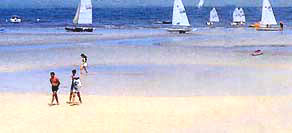 | 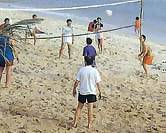 | ||
More popularly known as PD, Port Dickson is synonymous with sun and fun on the beach. Situated a mere 32km from Seremban and 60km from Kuala Lumpur, PD has long been a weekend retreat for many inland dwellers, especially those from the city seeking temporary escape from the hustle and bustle of a hectic and stressful life. Originally a town where charcoal was made and was once called Arang, it was later sought to be developed as a port. While it never did develop into a full-fledged port, PD's popular beaches attract thousands of weekend visitors from the cities. PD's main attraction is its 18km stretch of white sandy beaches that extend from Tanjung Gemuk in the north to Tanjung Tuan in the south. These are carefully protected by rows upon rows of casuarina palms, coconut trees, and elegant Bayan trees. Located near Cape Rachado (Tanjung Tuan), Blue Lagoon is the most famous picnic spot and is an excellent spot for the water sport enthusiast. PD usually comes alive in August each year during the "Pesta Port Dickson". This annual event draws in crowds from all over the country. This would be one great time to visit PD's beaches as there would be several activities and cultural events relating to the life of the locals. Accommodation should pose no problem for the visitor as this resort town has a place to stay for all. Accommodation can be found in the form of government chalets, hotels, and bungalows or even privately owned apartments that are rented out at reasonable rates. Food stalls can also be easily found along the beaches, as well as the town center. Being a seaside resort, PD's specialty would naturally be seafood. With frequent buses, commuter trains, and taxis plying between Kuala Lumpur and the resort, Port Dickson's appeal lies in its easy accessibility and the attractions of a beach getaway. Cape Rachado (Tanjung Tuan) Cape Rachado is renowned for its lighthouse that was reputedly built by the Portuguese in the 16th Century, which guides ships into the Straits of Malacca. This lighthouse that is built on a hillock overlooking the straits is until today still operational! On a clear day, one can see PD town and the outline of Sumatra across the Straits from this vantage point. Flocks of migrating sparrows, honey buzzards, swifts, hawks, and eagles stop over here between the months of September and March every year. Then there is a spot here where the legendary 15th Century Malay warrior of the Malacca Sultanate, Hang Tuah, was supposed to have set foot. | |||
Wednesday, August 12, 2009
Langkawi - Tuba Island, Malaysia
 | PULAU TUBA |
A mountainous island with very little lowland, the island of Pulau Tuba, about five kilometres south of Langkawi island, is the natural habitat for an interesting selection of wildlife. Undeveloped and undisturbed, with barely enough space for the dirt track that surrounds the island, it's a good place to see wildlife, up close and personal. Go hiking or bird-watching, or find a deserted beach or two to get a glimpse of some elusive creatures. Check with your hotel for information on trails to follow. Getting There Staying There | |
 | |
| |
Getting There Staying There |
 Nature-lovers must not miss Pulau Singa Besar, which contains a wildlife sanctuary located three kilometres off the southern tip of Pantai Tengah. It is a designated stop for the island-hopping boat.
 Tuesday, August 11, 2009
SURIA KLCC

Suria KLCC is Malaysia's premier shopping destination located at Kuala Lumpur prestigious commercial address, the Kuala Lumpur City Centre (KLCC). It offers an array of goods and services to please and pamper the needs of shoppers; from fashion, entertainment, arts & culture to local delicacies and international gourmets.
Set in the heart of Kuala Lumpur's Golden Triangle, Suria KLCC is surrounded by hotels, office buildings, a scenic park and dancing fountains, promising hours of leisurely pleasure. From whichever entrance you take, the excitement hits you the minute you step into the sensational splendour and diversity of the centre.
There is always something for everyone to savour at Suria KLCC:Monday, August 10, 2009
Pulau Sipadan
Pulau Sipadan
Long before anyone donned scuba diving equipment and jumped into the water, Pulau Sipadan was already recognised as something special. Above the waterline the island is only 30 acres (12 hectares) in area and is covered by untouched rainforest. In 1933, this tiny island was declared a bird sanctuary and at the end of 2004 was closed to tourists.
As the island is a protected area and a site of outstanding natural beauty, we urge you to behave responsibly when you visit, and make sure to control your buoyancy when diving. There is a National Park levy of US$ 11 per person per day entrance fee.
Mabul - Sweet Little Sister

Mabul Island has historically played a supporting role its famous neighbour in Sabah, Sipadan Island. Since Mabul is considerably larger, and Pulau Sipadan is now protected from overnight stays, its profile has greatly increased and resort owners have been able to construct a much higher standard of accommodation, albeit within the constraints of a remote getaway.
The island is covered in palm trees and fringed with fine beaches. Villagers live next door to the resorts and guests are free to stroll around the island, mingling with the locals. From Mabul Island, guests are taken the 25 to 30 minutes to Sipadan every day for diving. In addition they can dive the macro-world of Mabul, normally once a day.
The rest of this page contains information about:
How to Get There
Flight - Boat Transfer
The recommended flight in Sabah from Kota Kinabalu to Tawau leaves at 6:15 hrs and arrives at 6:55 hrs, with Malaysia Airlines (www.MalaysiaAirlines.com). This is the flight most resorts favour and guests will be collected here and driven for around one hour to Semporna, where the resort boat will transfer you the 45 minutes to Mabul Island.
Later flights are available but can cause problems with transfers and will almost certainly mean no diving on the first day. Air Asia (www.AirAsia.com) is free-seating and Malaysia Airlines is not. Both have emergency exit seats with acres of leg-room. For Air Asia you need to be at the front of the queue to secure one of these. For Malaysia Airlines ask for 14A or 14F, and spend the flight stretching your legs to the annoyance of your jealous neighbours.
There are direct flights from Kuala Lumpur to Tawau with Air Asia (07:20-10:05 hrs and 17:20-20:05 hrs) and Malaysia Airlines (12.40-15.30), but these will probably mean an overnight in Tawau and pick up from your hotel at 6:15 hrs.
Due to the dangers of flying after diving, some Mabul resorts may require you to sign a waiver. This is because some guests want to squeeze in as many dives as possible regardless of the risks. Guests who will be flying within 24 hours after departure from the resorts may be subject to diving restrictions on the last day.
Flights back from Tawau are Malaysia Airlines to Kota Kinabalu (16:10-16:55 hrs) or to Sandakan (17:30-18:10 hrs). If you do not wish to stay overnight in Kota Kinabalu, you can fly direct to Kuala Lumpur with Malaysia Airlines (19:05-21:45 hrs) and Air Asia (20:00-22:45 hrs).


Climate
The islands enjoy an equatorial climate, so temperature generally varies between 28 - 34°C during the day and drops to about 22°C during the nights. They are generally unaffected by the monsoon seasons which affect this part of South East Asia, although sporadic heavy rains come down around December and January.
Being islands, Sipadan and Mabul have cooling sea breezes that make even the high humidity level of 85 - 95% quite pleasant.
Friday, August 7, 2009
Sipadan Island

Sipadan Island is located in the centre of the richest marine habitat in the world, the heart of the Indo-Pacific basin. In this ecosystem, over 3,000 species of fish and hundreds of coral species have been classified.
In the waters around Sipadan, rare diving scenes are frequently seen such as schools of green and hawksbill turtles nesting and mating, schools of barracuda and big-eye trevally in tornado-like formations, pelagic species such as manta rays, eagle rays, scalloped hammerhead sharks and whale sharks. Therefore, Sipadan is popular with its unusually large numbers of green and hawksbill turtles which gather there to mate and nest. And it is not really rare for a diver to see more than seventy turtles on each dive.
Besides that, there is a mysterious turtle tomb lies underneath the column of the Sipadan Island. The turtle tomb was formed by an underwater limestone cave with a labyrinth of tunnels and chambers that contain many skeletal remains of turtles that have become lost and drown before finding the surface.
Currently, this beautiful island is in the care of Wildlife Department. The Wildlife Department has stationed several park rangers to oversee the state of nature of the island. In order to protect the world’s unique flora and fauna on the island as well as the underwater world, the Malaysian Government has made a decision that from the year 2005, no more overnight facilities shall be on the Sipadan Island itself. This implies that all dive operators on the Sipadan Island have to move and diving at Sipadan will be conducted from other destinations likes Mabul and Kapalai.
Why Go
The name of Sipadan is a legend in the diving circles, conjuring the images of patrolling hammerhead sharks, millions of colorful reef fish and, above all, dozens of sea turtles swimming peacefully everywhere. As one of the five top diving destinations in the world, Sipadan, the small rainforest-covered tropical island rising from a 700 meter abyss in the Celebes Sea, is an ultimate diving spot that a committed diver cannot miss.
Diving at Sipadan is certainly world class, so this place has attracted many diving lovers. It is well-known that divers are able to see about 150 species of butterfly fish within a single dive in Sipadan. Utilized by marine biologists as the indicators of coral reef health, a great number and species diversity of butterfly fish implies the abundance and diversity of corals. Pristine coral reefs are also landlord to other reef dwellers such as angelfish, snappers, wrasse, sweet lips, and parrotfish as well as the larger pelagic, barracudas, mantas, whales, dolphins and schools of hammerhead sharks.
Besides that, Sipadan Island is well-known with its vast numbers of Green and Hawksbill turtles which feed and breed within its waters before the females climb ashore to lay their eggs in the white sandy beaches. Others than that, diving near the coral reefs surprises you with incredible phenomena likes thousands of schooling chevron barracuda and big-eye trevally or ‘Jacks’. Moreover, floating inside such a tornado of fish is a truly breath-taking experience that is hard to beat.
On the other hand, Sabah is becoming one of the world famous location for ‘muck diving’. ‘Muck diving’ is used by divers to describe the search for rare and exotic small marine animals. Numerous rare and newly identified gobies can be found living in the corals, sand, mud and mangroves of Sabah, along with the rarely seen mimic octopus, neon patterned blue-ringed octopus, delicate flamboyant cuttlefish, psychedelic mandarin fish and ghost pipefish.
It is really worth to have a dive at Sipadan. Generally, the rate for three dives at Sipadan is just around RM260, plus RM40 for equipment (if required). Perhaps the rates might vary slightly among different operators. Boat transfers and packed lunch are included as well. Therefore you no need to worry about the food as there is no restaurant on the island.
It is vital to note that you need to have a permit from Sabah Parks in order to access the island, which will cost you RM40. Only 120 permits will be given out every day and they are typically obtained by the dive operators. You must make sure that the diver operator you choose is diving at Sipadan with permits, as some companies have been caught diving at the island without permits. You should check diver reviews of dive operators in the area before choosing as there are many have had customer complaints regarding faulty equipment.
Besides that, another tourist attraction of Sipadan is snorkeling. Eventually from the beach, the reef is easily accessible and parts of the reef further out can be reached by boat. There are a few dive tour operators bring snorkelers to the island at an all-inclusive rate of around RM170.
Best Time to Visit
You may make your way there any time all around the year but due to Sipadan is now a protected site, there is only 120 dives are allowed on Sipadan in a day. Therefore, it is highly recommended to dive as early as possible to beat the crowds and increase your chances of getting on the roster to dive.
Where to Stay
Previously, Sipadan Island was used to have resorts. In order to protect the environment, all the resorts were forced to close down around the year 2002. Hence, to dive on Sipadan, you have to stay somewhere nearby. There are resorts on the nearby islands likes Mabul which is 25 minutes away by boat and Kapalai which is 15 minutes away by boat.
As recommended, Sipadan-Kapalai Dive Resort is the best place to spend your night. It is just a few minutes by boat from the islands of Sipadan. Planned and built in full style as an airy, comfortable, sunny water village with no land in sight, Sipadan-Kapalai Dive Resort boasts a mile-long sandbank of powdery white sand where you can suntan at complete leisure while gazing out to the miles of brilliant turquoise stretching into the horizon offering the purest image of natural serenity. With the combination of sun and water in a unique and serene setting with friendly staff, Sipadan-Kapalai is an ideal stopover for you to have a great holiday experience.
Where & What to Eat
There are no restaurants on the island. You have to bring your own lunch and snacks there. Besides that, you are reminded to bring along your own water and drinks with you.
Nightlife
There is no nightlife on the Sipadan Island as it is not allowed to stay overnight on the island.
My to do List
- Diving
- Go to sandy beaches
- See the coral reef
-‘Muck diving’
- Snorkeling
Stay Away From
You should stay away from those companies that diving on Sipadan without permits from Sabah Parks. Make sure the diver operator you choose has diving permits from Sabah Parks.
Getting There
Getting to the Sipadan Island requires some effort. The best way for first timer is that by plane. At first, you may fly to Tawau from either Kuala Lumpur which is about three hour’s flight or from Kota Kinabalu which is about 50 minutes flight. Then, continue your trip by minivan or taxi to the port town of Semporna which will take you about one to two hours. And from there you may go to Sipadan itself by fast boat, which only spend one hour.
Thursday, August 6, 2009
Cherating Beach

The old Cherating Village has a blend of the modern and traditional. A stretch of road about 1km long runs parallel to the beach, dotted with charming and comfortable chalets, many of which face the beach front. Cherating has the perfect combination of great surf, a wide stretch of white-sandy beach, a wealth of accommodation, dining choices and a classic surfers' nightlife scene. Surfers linger for days and even months in this small enclave to catch the best waves and chill out with fellow surfers, exchanging the day's conquests at one of the chic bistros or bars.
In fact, "Surfers' Haven" has long been the description of old Cherating Village since the 70's. Each year, surfers from around the world return to Cherating to test out the surf and catch up with local acquaintances. Cherating beach is immaculate and breath-taking. So much so that Club Med decided to build its first Asian base right here. And surfers take the opportunity to have local friends take them through some of the most charming rural villages along the coast and soak in the gorgeous scenery along the way.
Key Tips
The best time to wind surf and surf is between November and December
How to get there
By Road
Cherating is a 3.5-hour drive from Kuala Lumpur via the scenic route to the east coast. There are buses to Kuantan departing daily from Kuala Lumpur. From Kuantan, there are regular bus and taxi services to Cherating. Alternatively, take a bus from Kuala Lumpur to Dungun or Kemaman in Terengganu, which is north of Pahang, and disembark at Cherating.
By Air
Malaysia Airlines operates daily flights to Kuantan. From the airport, Cherating is just 45 minutes away
Cherating started off as a backpacker's haven many years ago. These days, however, the range of accommodation has widened considerably to include everything from basic backpacker's hostels to 4-star hotels
Wednesday, August 5, 2009

Sabah is the second largest state in Malaysia covering 74,500 sq km. It is also one of the two Malaysian states on the island of Borneo. It is a paradise of natural beauty – largely carpeted by relatively untouched lush tropical rainforests, sprinkled with isolated tropical islands and home to three highest mountains in Malaysia.
- Mount Kinabalu - the highest mountain in Malaysia at 4,101 metres and the second highest in Southeast Asia after Puncak Jaya in Indonesia.
- Mount Trus Madi - second highest in Malaysia at 2,642 metres
- Mount Tambuyukon – third highest peak at 2,579 metres
Sabah is a nature lovers paradise come true, if you enjoy outdoor activities such as jungle trekking, mountaineering, diving, spelunking, Sabah is a must go destination on your travel plans.
Sabah currently has 6 national parks. One of it, the Kinabalu National Park, was designated as a World Heritage Site in 2000.
- Mount Kinabalu National Park
- Turtle Islands Park - conservation efforts for endangered sea turtles
- Tunku Abdul Rahman Park
- Pulau Tiga National Park
- Crocker Range National Park
- Tawau Hills Park
The Sipadan islands off the south eastern coast of Sabah, has been one of the top five dive sites in the world for years. This is attributed to unique underwater geography that encourages proliferation of wildlife. Leatherback turtles, barracuda and white tipped sharks are a common sight while diving in Sipadan.
Sabah has a hot humid climate with temperatures rarely dipping below 30C in the daytime. The wet season starts in November, with the onset of the northeast monsoon in Peninsular Malaysia and ends towards April, with the most rain falling in January.
Tuesday, August 4, 2009
Putrajaya 2009 Event

1 August 2009 Until 9 August 2009
Witness colourful flower displays, made specially for the event. Cultural performances are also held to highlight the wonders of Malaysia. All people are encourage to see many kind of flower until this weekend....
Monday, August 3, 2009
HAWAII

Choose an Island
KAUAI
The oldest and northernmost island in the Island chain is graced with dramatic, natural beauty. Outdoor adventures and romantic escapades flourish on Kauai.
* Explore the golden sand beaches of the Coconut Coast.
* See the massive Waimea Canyon, "The Grand Canyon of the Pacific."
* Take a boat ride to marvel at the towering cliffs of the Napali Coast.
> Take me to Kauai
OAHU
Home to the state capitol and the majority of Hawaii's population, Oahu is a vibrant mix of natural and cultural wonders with the modern arts, entertainment, and amenities of the 21st century.
* See pro surfers charge the big winter waves of the famous North Shore.
* Learn about American history at the memorials and museums in Pearl Harbor.
* Soak up the sun and learn to surf yourself on legendary Waikiki Beach.
> Take me to Oahu
MOLOKAI
With almost half of its population being of native Hawaiian ancestry, Molokai is an island that has preserved its connection to the past and its love for the outdoors.
* Step back to a simpler time in the sleepy town of Kaunakakaki.
* View the verdant flora in Halawa Valley.
* Learn about the works of Father Damien at Kalaupapa Settlement.
> Take me to Molokai
LANAI
Without a single traffic light, Lanai is a true island getaway for luxury, romance, and privacy away from crowds.
* Play golf at Lanai's two prestigious courses.
* See the rock formations at Keahiakawelo, "The Garden of the Gods."
* Off-road amongst the pine trees along Munro Trail.
> Take me to Lanai
MAUI
The second largest island is home to what some believe are the best beaches in the world, as well as Humpback whales who migrate off Maui's shores every winter.
* Wake up early to catch the sunrise atop Haleakala Crater.
* Stroll through historic Lahaina, and learn about Maui's whaling past.
* Drive the long and winding road to Hana for spectacular scenery.
> Take me to Maui
HAWAII'S BIG ISLAND
Bigger than all of the other islands combined, the island of Hawaii, or Hawaii's Big Island, is vast enough to hold 11 of the world’s 13 climactic zones—from sandy beaches to snowcapped mountains.
* See waterfalls, rainforests, and botanical gardens in Hilo.
* Snorkel, scuba, or fish off the Kona Coast.
* View Kilauea, the world's most active volcano in Hawaii Volcano's National Park.
Subscribe to:
Comments (Atom)


